0%

Choosing an Acoustic Guitar manufacturer involves more than comparing prices or glossy product photos. The question “China Top 10 Acoustic Guitar Manufacturers?” calls for a practical look at companies, not an unquestioned ranking. Buyers should compare product range, production capabilities, quality-control processes, and experience serving their intended market. These details can help distinguish a factory suited to large OEM orders from one better equipped for smaller custom runs.

A useful comparison also considers materials, construction, finishing, and consistency between samples and bulk orders. Ask how a manufacturer checks neck alignment, fretwork, bracing, and tuning stability. These factors affect how an instrument feels and sounds after it leaves the showroom. Clear communication matters, too. Specifications, sample approval, packaging, and production timelines should be discussed before placing an order. Small details count.

This guide introduces ten manufacturers for readers who want a starting point for research. Company capabilities and product offerings can change, so verify current information directly with each manufacturer. A neat ranking can hide important differences, and available information may not answer every question. That is worth remembering. Use the list to compare options, request documented specifications, and assess samples against your own standards. The best choice depends on your budget, target customer, order size, and expectations for tone and finish. A careful comparison may take time, but it can prevent expensive surprises later.
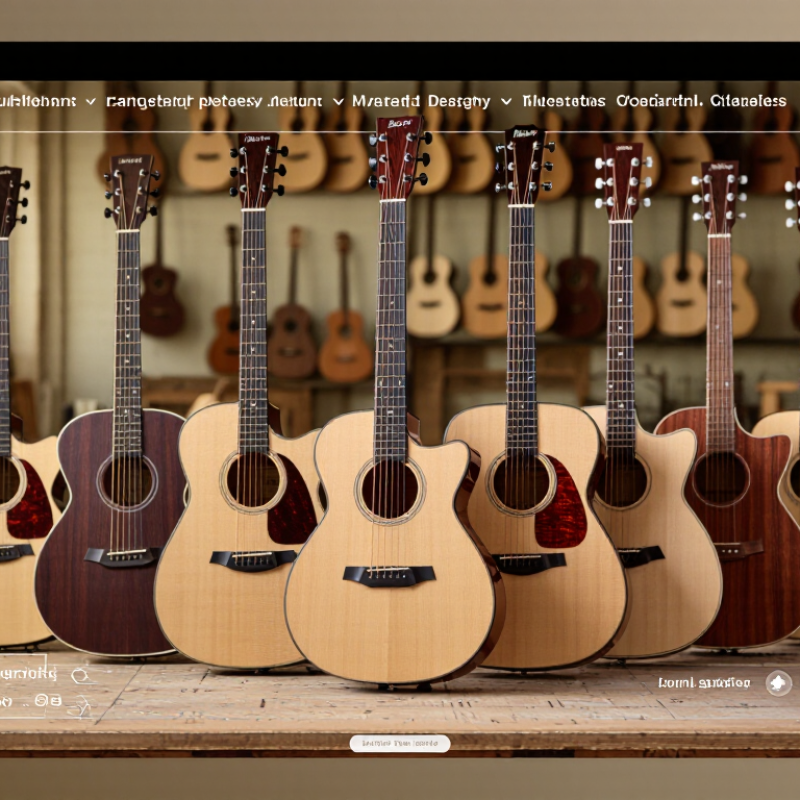
China Top 10 Acoustic Guitar Manufacturers?

China’s Acoustic-Guitar Industry: OEM Hubs and 6- and 12-String Product Lines

China’s acoustic-guitar supply chain is concentrated in manufacturing clusters across Guangdong, Shandong, and Zhejiang. OEM factories may handle body shaping, neck setting, finishing, and final setup under one roof, while smaller workshops specialize in particular stages. For buyers, the useful questions are practical: How is neck relief checked? Are fret ends inspected by hand? Can the factory hold action height consistently across a production run? Small details matter. A clean sample does not guarantee uniform bulk production.


Grand View Research valued the global guitar market at about US$11.8 billion in 2023, covering acoustic and electric instruments; it is not an acoustic-only figure. UN Comtrade’s HS 920290 category also groups guitars with other string instruments, limiting precise comparisons of acoustic-guitar exports. Six-string models remain the standard OEM offering, with options such as solid or laminated tops, cutaways, and different scale lengths. Twelve-string lines need tighter control: paired strings increase tension, and setup must prevent buzzing without making fretting uncomfortable. These distinctions sound obvious, yet specifications are sometimes vague. That deserves a second look. Ask suppliers for measured action, neck-relief, and inspection records—not just a polished sample.

How to Compare 10 Manufacturers by Capacity, Export Data, and OEM Services

When comparing ten acoustic guitar manufacturers, treat stated capacity as a starting point, not a guarantee. Ask how many instruments each factory can produce monthly and how much capacity is already booked. A line with several assembly stations may still slow down during neck fitting or finishing. Numbers need context. Request recent production records, then compare them with sample lead times and order schedules.

Export data can help verify experience, but shipment totals alone reveal little about quality. Check destination markets, shipment frequency, and whether the records cover guitars rather than mixed musical goods. Ask for documents that support the figures, with sensitive details reasonably removed. A tidy spreadsheet can look persuasive; it may still leave gaps. That is worth admitting when comparing suppliers.

For OEM services, compare what each factory can actually customize: body shape, tonewoods, finishes, hardware, packaging, and private-label specifications. Ask who approves drawings and how changes are recorded. Request a pre-production sample, then inspect fret ends, finish consistency, tuning stability, and carton protection. Also ask how defects are logged and corrected. A small detail, such as uneven bridge placement, can delay approval. Some comparisons will remain imperfect because factories define capacity and service scope differently. Keep the same questions and scoring method for all ten.

Factory Profiles: Body Shapes, Product Ranges, and Solid-Top Options

A useful top-ten comparison of Chinese acoustic-guitar manufacturers should describe the factory, not just its catalogue. Record which body shapes each workshop builds: dreadnoughts for fuller projection, concert bodies for a smaller feel, and auditorium or travel models for specific playing needs. Check whether its range includes steel-string and nylon-string instruments. Small details matter. A thick neck finish or sharp fret ends can change the playing experience more than a polished product photo suggests. NAMM’s 2024 Global Report estimated U.S. music-products retail sales at about $17.1 billion in 2023. That figure signals a large market, but it is not an acoustic-guitar sales forecast.

For each factory profile, separate all-laminate models from solid-top options, and identify the top wood and back-and-side construction. Ask for sample specifications, setup details, and consistent production photos; verify claims against a physical sample when possible. A solid spruce top may respond differently from a laminate top, but it does not automatically make a better guitar. Build quality still depends on bracing, fretwork, and assembly control. Humidity testing is worth asking about. It is easy to overlook. One limitation: online factory profiles rarely reveal how consistently a workshop maintains quality across large orders, so buyers should treat catalogue descriptions as a starting point.

Key Build Specs: Common 24.75–25.5-Inch Scales and Six-String Setups

For acoustic guitars, scale length usually falls between 24.75 and 25.5 inches. A 24.75-inch scale can feel slightly softer under the fingers, especially during long chord sessions. At 25.5 inches, strings often feel firmer, with a little more room between frets. The difference is subtle, not a shortcut to judging tone. Body size, bracing, strings, and setup all matter. Small details matter.

A standard six-string layout should offer clean intonation across the neck, from open chords to fretted notes near the body. Check that the nut slots hold strings neatly and that the saddle follows the bridge angle. String gauge also changes feel and tension, so a scale that suits one player may not suit another. Ask how instruments are checked after assembly, including action and fret consistency. These measurements give buyers a useful starting point, though factory specifications do not guarantee a comfortable guitar. That part can be a little imperfect. Playability still needs a real hands-on check.

Quality Control Metrics: Action, Intonation, Humidity, and Defect Rates

For buyers comparing acoustic guitar manufacturers in China, quality control is more useful than polished showroom photos. Action should be measured at the 12th fret, on both bass and treble strings, with the string gauge and tuning recorded. A low measurement can feel fast but cause buzzing; a high one may tire the fretting hand. There is no single ideal figure for every player. Small shifts matter.

Intonation checks should compare each open string with its fretted 12th-fret note using a stable tuner. A sharp fretted note can point to saddle compensation, excessive action, or inconsistent setup. The test should be repeated after tuning and stretching the strings, not recorded once and treated as proof. That detail is often missed. Humidity logs matter too: wood can move during storage and shipping. Many workshops aim for roughly 45–55% relative humidity, while noting temperature and measurement location.

Defect rates need clear definitions. A factory might report the share of instruments failing final inspection, but buyers should ask what counts as a defect and how many units were checked. Look for documented checks of fret ends, finish, bracing, tuning stability, and neck relief. Sample records are stronger evidence than a single perfect instrument. Even careful systems have exceptions; consistent measurement and honest rework records make those exceptions easier to understand.

China Top 10 Acoustic Guitar Manufacturers? - Quality Control Metrics: Action, Intonation, Humidity, and Defect Rates

Illustrative comparison: The anonymous production profiles and figures below are synthetic examples, not verified measurements, company rankings, or audited data from actual manufacturers. They demonstrate common acoustic-guitar quality-control metrics.

Anonymous Profile Low-E Action at 12th Fret (mm) High-E Action at 12th Fret (mm) 12th-Fret Intonation Error (cents) Assembly-Room RH (%) Sample Final-Inspection Defect Rate (%)
Profile 012.41.8±445–551.8
Profile 022.61.9±540–552.4
Profile 032.31.7±345–601.5
Profile 042.82.0±640–603.1
Profile 052.51.8±445–552.0
Profile 062.21.6±345–551.2
Profile 072.71.9±540–552.7
Profile 082.41.7±445–601.9
Profile 092.92.1±740–603.6
Profile 102.51.8±445–552.2

Metric notes: Action is string-to-fret clearance measured at the 12th fret; intonation error is the absolute pitch deviation at the 12th fret after tuning the open string; RH means relative humidity; and the defect rate is the percentage of inspected units failing a defined final-inspection checklist. Results depend on string gauge, tuning, setup, climate, sampling plan, and inspection criteria. These example figures should not be treated as industry averages or verified company performance.

FAQS

Where are China’s acoustic-guitar manufacturing clusters located?

Major clusters are in Guangdong, Shandong, and Zhejiang. Some factories manage shaping, neck setting, finishing, and setup in one place.

What should buyers check beyond a polished sample?

Ask for measured action, neck relief, and inspection records. A clean sample alone cannot show how consistent a full production run will be.

What features are common in six-string models?

Options include solid or laminated tops, cutaways, and different scale lengths. Check intonation, nut slots, and saddle alignment across the neck.

What makes twelve-string guitars harder to set up?

Paired strings increase tension. Setup must reduce buzzing without making fretting uncomfortable. Small details matter.

What scale lengths are common for acoustic guitars?

Many models use scales from 24.75 to 25.5 inches. The shorter scale may feel softer; the longer one may feel firmer.

Does scale length alone determine how a guitar feels?

No. Body size, bracing, strings, and setup also matter. I would not use scale length as a shortcut.

How should action and fret consistency be checked?

Ask how the factory measures action and inspects frets after assembly. Then try the guitar in person, if possible. Still, check by hand.

Do published market figures show acoustic-guitar sales specifically?

Not necessarily. One cited global market estimate covers acoustic and electric guitars, while a trade category groups guitars with other string instruments. Those figures have limits.

Conclusion

China’s acoustic-guitar industry serves a broad range of buyers through manufacturing hubs that produce six- and twelve-string instruments for domestic and export markets. Comparing ten manufacturers involves more than reviewing product catalogs: buyers can also assess production capacity, available export information, customization options, and the scope of OEM services. Factory profiles may differ in body shapes, product ranges, and the availability of solid-top models, making it important to match each manufacturer’s strengths with the intended price point and market.

Common specifications include scale lengths from 24.75 to 25.5 inches, alongside standard six-string setups and selected twelve-string designs. Consistent quality control is equally important. Useful measures include string action, intonation accuracy, humidity management, and defect rates, supported by clear inspection procedures. Together, these factors provide a practical framework for evaluating manufacturing capability, product suitability, and reliability when sourcing an Acoustic Guitar.

Elara Grace

Elara Grace

Elara Grace is a marketing professional with a deep understanding of the company’s products, customer needs, and the practical considerations that shape purchasing decisions. She regularly contributes expert articles to the company website, turning product knowledge and industry insights into......